A Notion Alternative for People Who Just Want to take quick notes, and nothing else.
Notion is an entire workspace. Hayaku Notes just helps you jot down what you need to right away. Which one should you try? Depends on your needs.
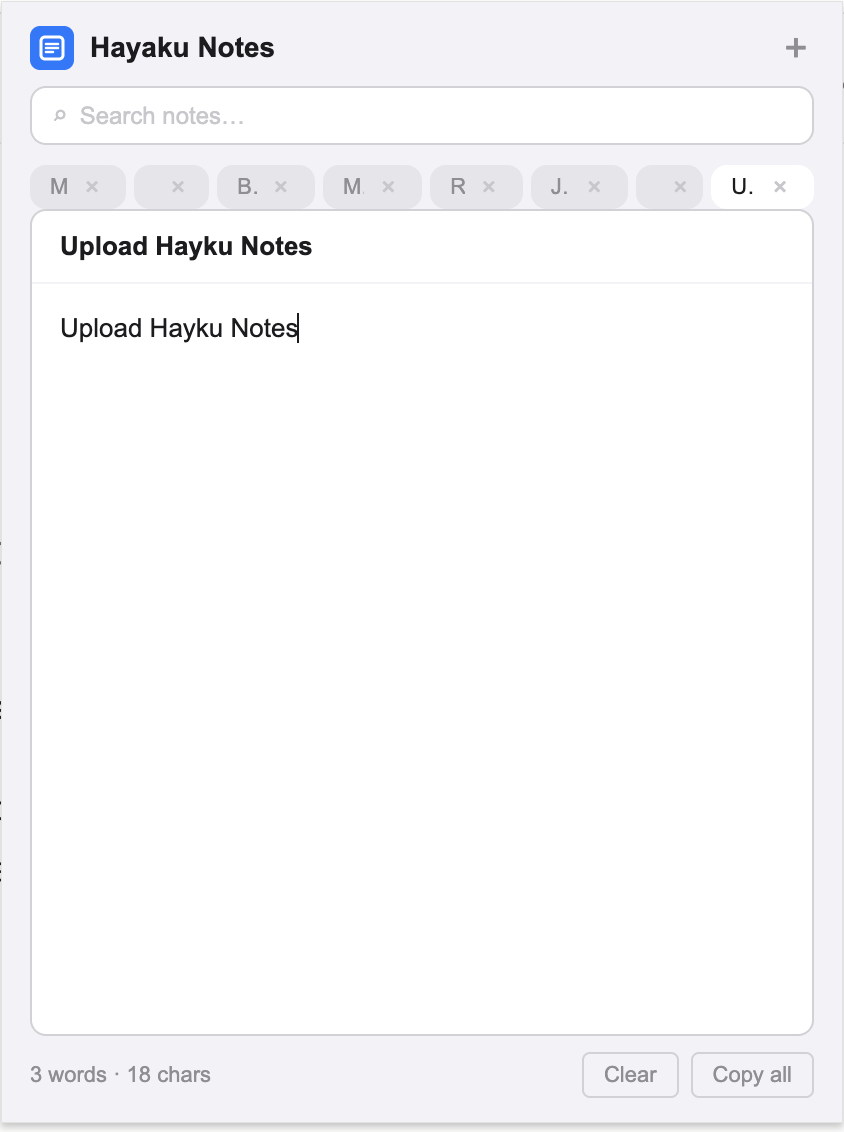
Tired of leaving Chrome just to take simple notes? If you are searching for a Notion alternative, the odds are high that you have already experienced this: you are reading an article, watching a video, or working inside a web app, a thought appears, and you need to capture it before it vanishes. So you open Notion. The workspace loads. You wait for the sidebar to populate. You pick a page, or you create a new one, or you hunt for the block where this thought belongs. By the time the cursor is blinking, the idea has dissolved into the background noise of your day. Hayaku Notes was built to remove that detour entirely. It is a Chrome extension that drops a notepad over whatever tab you are already in. One click, no new tab, no load time, no context lost. This article walks through where Notion excels, where it creates friction for quick capture, and why some users keep Notion for the heavy work and install Hayaku for the moments in between.
What Notion does that Hayaku never will
Notion is a workspace operating system. Databases with relational properties, kanban boards, team wikis, embedded calendars, and collaborative editing are features that Hayaku Notes does not attempt and is not trying to add. If you are building a content pipeline, tracking job applications, or running a team knowledge base, Notion is the correct tool and Hayaku is not a replacement for it. The comparison only matters for the narrower use case of personal, spontaneous note-taking.
The detour that costs you the thought
Notion runs as a full web application. Every time you open it, the workspace initializes, your sidebar tree renders, and your recent pages load. On a slower connection this can take several seconds. For a deep planning session, several seconds is irrelevant. For a fleeting thought — a phone number, a sentence you want to remember, a correction to something you just read — several seconds is often the difference between capture and loss. The thought arrives, you begin the process of opening Notion, and before the interface is ready, your attention has already moved on.
Hayaku eliminates the detour because it lives inside Chrome. You click the toolbar icon and the notepad appears over your current page in less than a second. The article you were reading stays visible behind it. You type, you close it, and you resume reading. The context never shifts.
Hierarchy versus flatness
Notion rewards structure. Nested pages, linked databases, and custom templates let you build an elaborate organisation system that stays tidy for months. The cost is that the system itself requires maintenance. You have to decide where a note belongs, file it correctly, and remember that location when you need it again. For some users, the system becomes a project of its own, and the actual writing becomes secondary.
Hayaku uses a flat structure. Your notes live as tabs inside the extension. There are no folders to create, no parent pages to assign, and no filing logic to maintain. The trade-off is that it will never scale to a complex knowledge base. The benefit is that there is nothing to set up and nothing to decay when you stop maintaining it.
The account step
Notion requires an email, a password, and a verification flow before you can write your first word. For a tool you plan to use for years, that is a reasonable one-time cost. For a tool you want to try right now because a thought is slipping away, it can be the barrier that kills the habit before it begins.
Hayaku has no account. You install the extension and you start typing. Your data stays in your browser using Chrome’s local storage. Nothing is uploaded to a server. If keeping your notes off the cloud matters to you, Hayaku is one of the non-cloud note options that keep everything on your own device. It is also part of the smaller group of note apps that skip the login entirely, which removes the activation energy that stops some people before they start.
Finding what you wrote
Notion’s search is powerful across a well-organised workspace. It indexes page titles, database properties, and body content. But if your quick notes are scattered across random drafts, daily logs, and uncategorised pages, the results can be noisy. You may find yourself opening three or four pages to locate the right sentence.
Hayaku uses a single real-time search that filters your note tabs as you type and highlights the matching text inside each note. You remember a fragment, you type it, and the note surfaces. There are no nested locations to check and no database properties to confuse the results.
What it costs to keep
Notion’s personal plan is free and generous, but advanced features — longer version history, larger uploads, and AI assistance — sit behind a monthly subscription. For users who dislike accumulating recurring charges, that model can be a long-term concern.
Hayaku is free for up to fifty notes, which is enough to decide whether the tool fits your workflow. After that, a single payment of $5.97 unlocks unlimited notes permanently. There is no subscription and nothing to cancel later. If you specifically want a tool that does not become another monthly bill, Hayaku is one of the note apps that charge once instead of every month.
Who should keep using Notion
If you manage complex projects, share workspaces with a team, rely on databases and templates, or treat your notes as a structured knowledge base, Notion is the better tool. Hayaku Notes is not trying to replace that. It is a single-purpose extension for a different job.
Who should try Hayaku instead
If you find yourself opening Notion less and less because the load time feels disproportionate to the size of the note, if your quick-capture habit keeps dying at the account-setup or page-finding stage, or if you just want a notepad that appears over your current tab without navigating away, Hayaku is worth testing. The free tier costs nothing but the install time.
The bottom line
Notion is a workspace. Hayaku is a notepad. One is not objectively better; they are built for different frequencies and depths of use. If you need a workspace, Notion is the answer. If you are tired of leaving Chrome just to take simple notes, Hayaku is the alternative some users switch to. The test is straightforward: install it, use it for a week, and notice whether the notes you meant to keep actually get written down.
Stop leaving Chrome to take a note.
The yellow icon sits in your toolbar, one click from a blank pad.
Get it on Chrome Web Store